
A Word from Joel - December 3, 2025
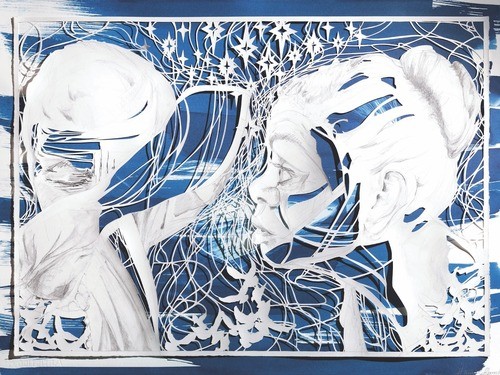
“Zechariah and the Angel”
by Hannah Garrity
Inspired by Luke 1:5-13
by Hannah Garrity
Inspired by Luke 1:5-13
“In the days of King Herod of Judea, there was a priest named Zechariah.” Luke 1:5
Our theme for Advent this year is, “What do you fear?” For some of us, fear lives right on the surface, while for others it is hidden. Psychologists tell us that fear is a universal primal emotion tasked with keeping us alive. All of us have fear whether we are aware of it or not. If you are unaware of your fear, chances are it has more control over you than you know. Advent is a season of hope, and durable hope emerges only when we name and face our fears.
Luke’s birth narrative begins with a detail we easily overlook, “In the days of King Herod.” Herod was both incredibly accomplished and brutally dangerous. He was called “Herod the Great” because he built enormous structures throughout Israel, several of which remain to this day. Herod built and built and built, yet he was also notorious for destroying the people closest to him and ruling his people with an iron fist. Like many politicians before and after him, Herod pursued power above all else, and his greatest fear was losing that power. This made him incapable of love. Jesus is born into a world in which the people of God were ruled by a megalomaniacal tyrant who exacted wealth from his people, while brutalizing them. If you were a regular person, you had every reason to be afraid and very little hope that things would get better. The only reason to hope was that God might break in, and that’s exactly what God did, but not in the way we expect. God didn’t call a soldier or a politician. God breaks in by telling an elderly priest that his prayers had been heard.
If you were in Zechariah’s shoes and someone told you that two thousand years from now, people all over the world would remember and celebrate someone from that time, you’d bet on Herod, or maybe Caesar. You certainly wouldn’t think a child born to a withered couple and unwed mother would be sung about and celebrated while Herod would be a mere footnote in their story. Yet that’s exactly what’s happened. For all his purported greatness, Herod is remembered for his brutality and for his role in the birth of a new king, one who reigns not with fear and violence but love and compassion. Who could have ever seen that coming? Today, God still hears the prayers of the oppressed and Jesus’ kingdom lives on in every act of vulnerability, compassion, forgiveness, and love. God is the eternal presence of love that assures us that in all our fears both big and small, we are loved and God is near.
Our theme for Advent this year is, “What do you fear?” For some of us, fear lives right on the surface, while for others it is hidden. Psychologists tell us that fear is a universal primal emotion tasked with keeping us alive. All of us have fear whether we are aware of it or not. If you are unaware of your fear, chances are it has more control over you than you know. Advent is a season of hope, and durable hope emerges only when we name and face our fears.
Luke’s birth narrative begins with a detail we easily overlook, “In the days of King Herod.” Herod was both incredibly accomplished and brutally dangerous. He was called “Herod the Great” because he built enormous structures throughout Israel, several of which remain to this day. Herod built and built and built, yet he was also notorious for destroying the people closest to him and ruling his people with an iron fist. Like many politicians before and after him, Herod pursued power above all else, and his greatest fear was losing that power. This made him incapable of love. Jesus is born into a world in which the people of God were ruled by a megalomaniacal tyrant who exacted wealth from his people, while brutalizing them. If you were a regular person, you had every reason to be afraid and very little hope that things would get better. The only reason to hope was that God might break in, and that’s exactly what God did, but not in the way we expect. God didn’t call a soldier or a politician. God breaks in by telling an elderly priest that his prayers had been heard.
If you were in Zechariah’s shoes and someone told you that two thousand years from now, people all over the world would remember and celebrate someone from that time, you’d bet on Herod, or maybe Caesar. You certainly wouldn’t think a child born to a withered couple and unwed mother would be sung about and celebrated while Herod would be a mere footnote in their story. Yet that’s exactly what’s happened. For all his purported greatness, Herod is remembered for his brutality and for his role in the birth of a new king, one who reigns not with fear and violence but love and compassion. Who could have ever seen that coming? Today, God still hears the prayers of the oppressed and Jesus’ kingdom lives on in every act of vulnerability, compassion, forgiveness, and love. God is the eternal presence of love that assures us that in all our fears both big and small, we are loved and God is near.
Posted in Fear, Advent, Luke
Posted in Hannah Garrity, Luke, The Gospel of Luke, Luke 1:5-13, King Herod, Judea, Advent, Fear, Zechariah, God, Love, Jesus
Posted in Hannah Garrity, Luke, The Gospel of Luke, Luke 1:5-13, King Herod, Judea, Advent, Fear, Zechariah, God, Love, Jesus
Recent
Archive
2026
January
February
March
2025
January
February
March
April
May
June
July
August
September
October
November
2024
June
No Comments